IntraSkill
Skill–Model Co-evolution for Shopping Agents · ShopSimRL
Project Report · English · 简体中文 · Documentation · Experiment report
IntraSkill proposes a skill–model co-evolution training system and tests it in a simulated shopping environment. Built on ShopSimulator and slime, the project trains Qwen3.5-4B to search, inspect product variants, satisfy persona-grounded preferences, and purchase through function tools while an external procedural skill bank is measured and revised.
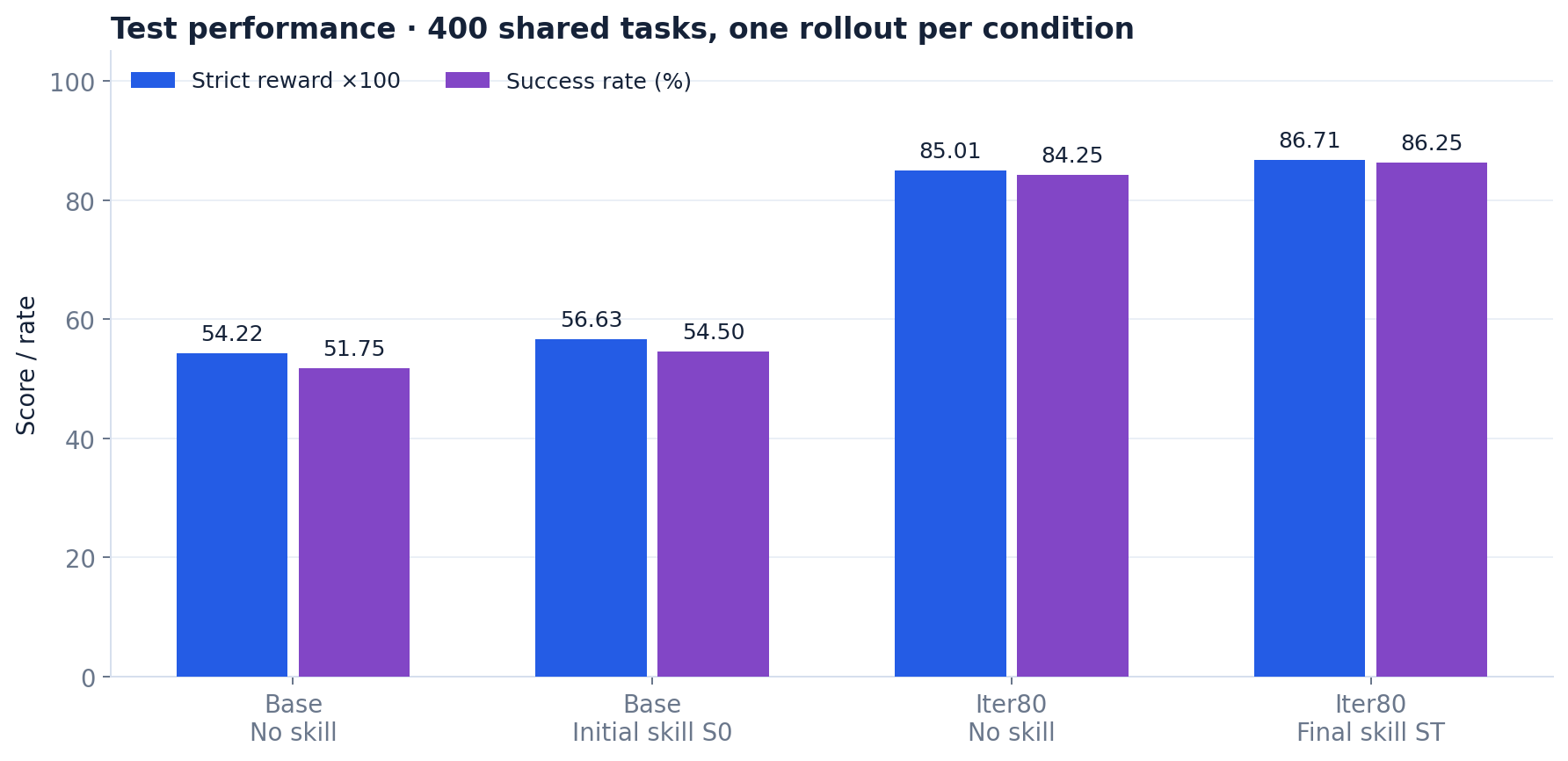
The released run improves skill-free test success from 51.75% to 84.25%. With its final skill, the trained model reaches 86.25%. These are results from one training run on the project's local protocol, not a comparison against the upstream benchmark leaderboard.
Why co-evolve?
Some agent knowledge should remain external. Shopping procedures resemble mutable SOPs: they should be readable, checked when needed, and updated without retraining. But a stale or already-mastered instruction can consume context and constrain exploration. IntraSkill therefore keeps one skill for the whole shopping scene and evolves minimal independent chunks inside it. Useful chunks guide sparse-reward exploration; randomized omission asks the model to act with less support; a separate paired gate retains, rewrites, or retires each chunk according to its residual contribution at the current checkpoint.
This design sits between skill-only evolution and complete internalization. Trace2Skill and SkillRL motivate trajectory-grounded bank revision; SKILL0 progressively withdraws category-organized skills toward skill-free deployment; EDGE co-evolves a model and experience bank while mixing scaffolded and unscaffolded rollouts inside a group; Skill1 jointly trains skill selection, use, and distillation. IntraSkill instead keeps each GRPO group's prompt treatment identical and estimates chunk contribution outside training on a frozen checkpoint. Read the full background and method.
The task, environment, and reward chapter shows the user_persona structure, the visible/private information boundary, the local shopping state machine, how purchase reward is constructed, and a complete four-turn purchase example.
How it works
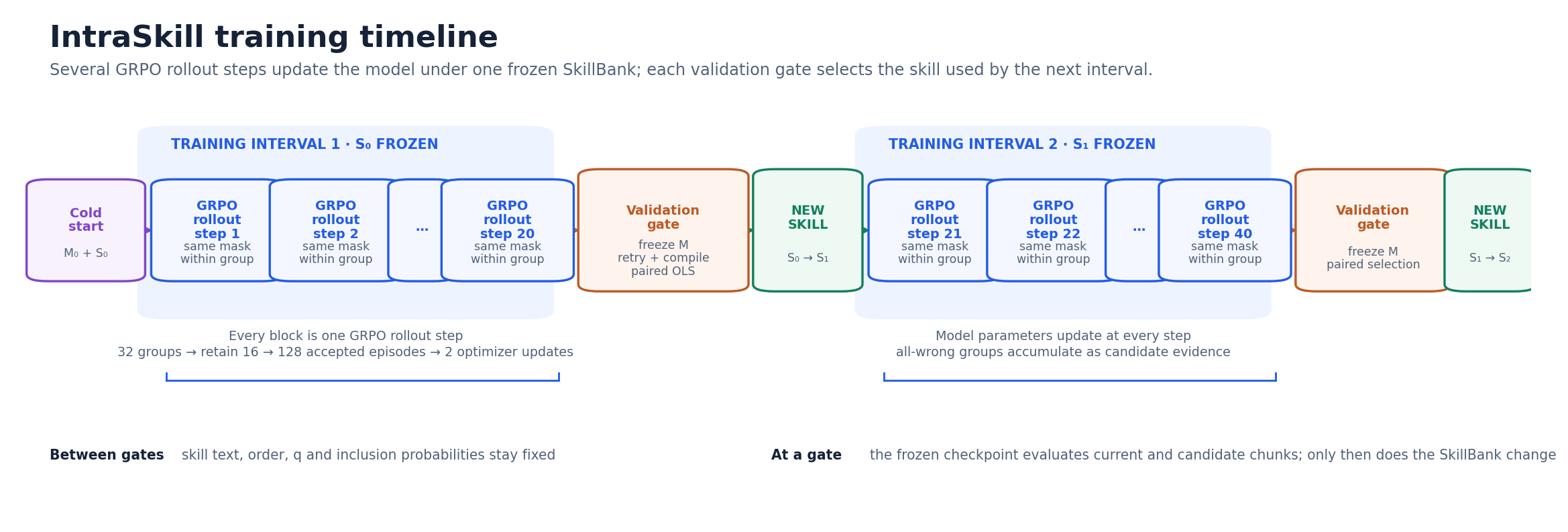
- Initialize a shopping skill. Trace2Skill distills training trajectories into independently maskable procedural chunks.
- Train with shared masks. Each GRPO group contains eight trajectories under one shared context. A fixed probability
q = 0.20removes all skills; assisted groups sample chunks using contribution-dependent inclusion probabilities. - Investigate the failure frontier. All-wrong groups receive a diagnostic full-skill retry. Remaining failures feed the analyst and compiler, which propose
ADDorREWRITEcandidates. - Validate every 20 rollout steps. The frozen checkpoint runs bare and randomized-mask validation on the same 400 tasks. The gate fits
R_i − B_i = C_iᵀβ + ε_iwithout an intercept, resolves rewrite families, and retains positive-coefficient winners up to the chunk budget.
Model updates compare trajectories within a fixed context; skill updates compare interventions at a frozen checkpoint. See the full background and method, the method proposal, and the paired-validation contract.
Released experiment
| Model | Skill context | Strict reward | Success |
|---|---|---|---|
| Base | None | 0.5422 | 51.75% |
| Base | Initial S₀ | 0.5663 | 54.50% |
| Iter80 | None | 0.8501 | 84.25% |
| Iter80 | Final Sₜ | 0.8671 | 86.25% |
All four conditions complete the same 400 test tasks, one rollout per task. The persona split is 3726 train / 400 validation / 400 test. The release comprises 80 rollout steps in four rounds, with 20,480 generated episodes and 10,240 episodes admitted to the trainer. With global batch size 64, each 128-episode rollout batch yields two optimizer updates; rollout steps and optimizer updates are different units.
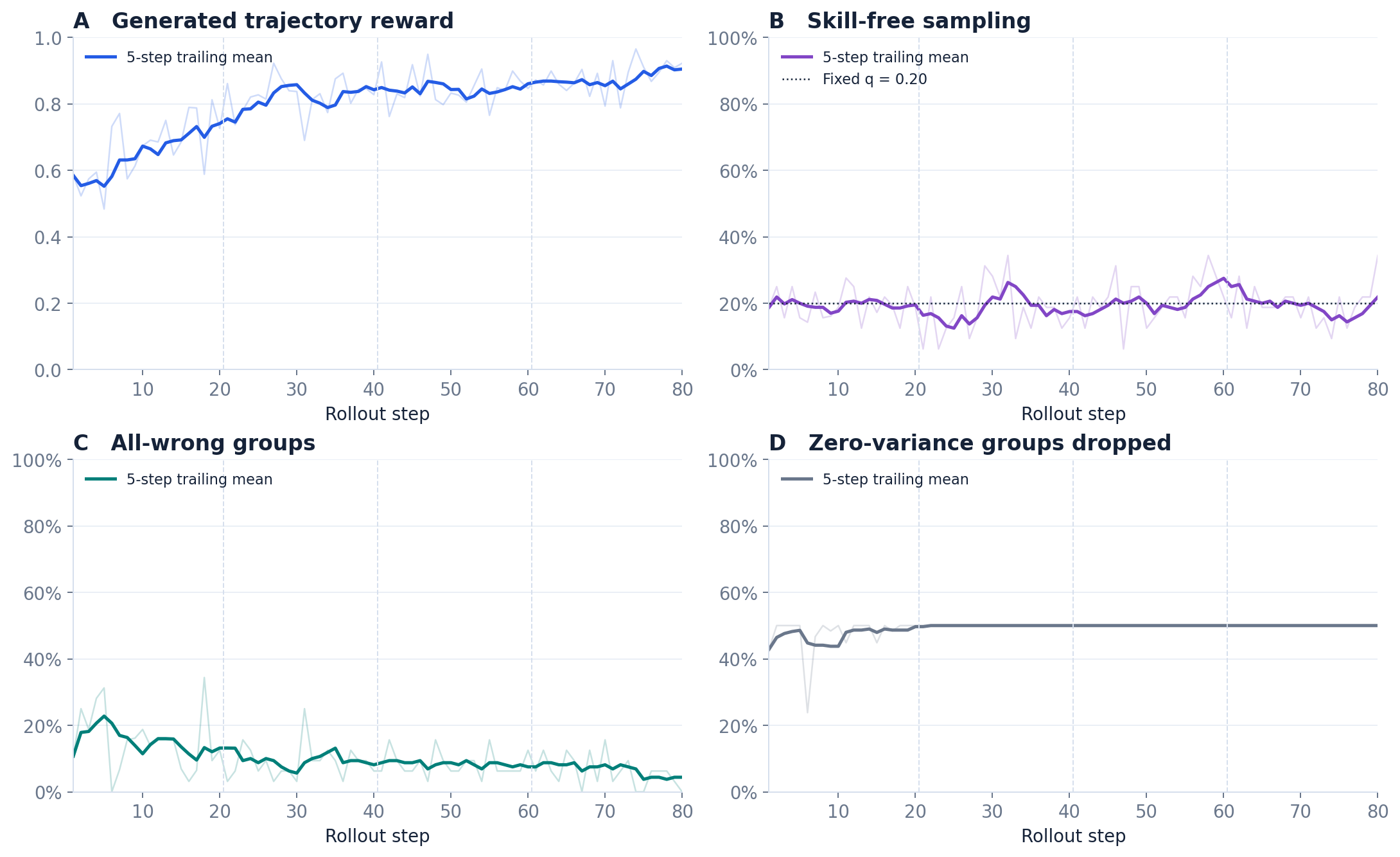
The active skill changes from 10 → 7 → 5 → 8 → 8 chunks. Skill-free validation success increases from 74.75% at step 20 to 86.00% at step 80. The contribution gate uses validation, while the four-condition table uses test.
What this establishes: the trained checkpoint performs substantially better without external skills. The paired 95% confidence interval for its success gain is +27.50 to +37.50 percentage points.
What remains open: the final skill's additional success gain is +2.00 points, with a paired 95% interval of −0.50 to +4.75. There is no plain-GRPO, fixed-skill, no-mask, or repeated-training-seed control in this release. Contribution ranking is also inconclusive: the base-model appendix has top4 / bottom4 / one random4 success of 51.75% / 55.00% / 54.25%. These results do not isolate the causal benefit of co-evolution over ordinary RL.
Behavior and optimization
The analysis covers 110,997 saved training turns, 20,480 generated episodes, and 3,600 completed evaluations. On the fixed 400-task bare validation set, Base → Iter80 reduces average generation from 282.39 to 159.46 tokens per turn (−43.5%). Model steps change from 6.01 to 5.56, but their paired interval spans zero. Successful training paths stay around 4.5–4.8 steps; remaining failures are longer and search more often. Invalid environment actions decrease while protocol parsing errors increase.
Four complete W&B histories add 160 optimizer updates. Their 3,118 overlapping numerical values match local logs exactly. The report separates token entropy, PPO diagnostics, gradient norms, admitted Sample length, and throughput from episode-level behavior.
Read the behavior analysis and optimization analysis. The bilingual project site contains seven full project-report chapters, an interactive behavior explorer, all skill versions, a searchable source-document library, and downloadable episode/turn data.
Reproduce the analysis — no GPU required
Python 3.10 or later:
python -m pip install -e ".[analysis,site]"
python scripts/analyze_training.py
python scripts/analyze_behavior.py
python scripts/analyze_wandb.py
python scripts/plot_training.py
python scripts/plot_behavior.py
python scripts/plot_wandb.py
python scripts/plot_method.py
python scripts/build_site.py
python scripts/check_publication.py
python -m http.server 8000 --bind 127.0.0.1 --directory _site
Open the local project page. It includes English/Chinese text, an interactive training chart, a skill-version explorer, and downloadable data. The static build is compatible with GitHub Pages; see publishing instructions.
The analysis rebuilds from the committed numerical extracts. It checks test pairing and refits all four published gates. To refresh these extracts from a complete local runs/, use python scripts/analyze_training.py --refresh-local. Full traces, model weights, W&B logs, and credentials are not required to view or rebuild the public analysis.
Run the agent or train a model
- Prepare and start the bundled environment using the ShopSimulator setup guide.
ShopSimulator/is a regular directory, not a submodule. - Serve the appropriate base or trained checkpoint on the endpoint configured in the evaluation YAML. The checkpoint ID records provenance; it does not load or verify the served weights.
- Inspect a plan, then run an evaluation:
python scripts/run_shopsimrl.py plan configs/qwen35_4b_test.yaml
python scripts/run_shopsimrl.py run configs/qwen35_4b_test.yaml
| Condition | Configuration |
|---|---|
| Base, no skill | qwen35_4b_test.yaml |
| Base + S₀ | qwen35_4b_test_trace2skill_equipped.yaml |
| Iter80, no skill | qwen35_4b_test_final_free.yaml |
| Iter80 + Sₜ | qwen35_4b_test_final_pair.yaml |
Use a fresh experiment name/output directory for a new run; do not overwrite frozen runs or reuse manifests after changing weights. GPU training additionally requires the slime/SGLang/Megatron stack, model weights, and an analyst API. Follow the training guide, not the lightweight analysis installation above.
Repository map
| Path | Purpose |
|---|---|
shopsimrl/ |
Agent runtime, evaluation, curriculum, training adapter, Trace2Skill |
ShopSimulator/ |
Bundled local environment, frozen splits, corpus preparation, replay UI |
slime/ |
Training framework checkout |
configs/, scripts/ |
Experiment entry points and analysis/build commands |
artifacts/ |
Frozen skill banks, evaluation excerpts, reproducible analysis and figures |
site/ |
Bilingual static project-page source |
docs/, tests/ |
Research/engineering documentation and regression tests |
runs/, data/ |
Local full experiments and generated data; ignored by Git |
Provenance and acknowledgements
This project builds on ShopSimulator, slime, and Qwen3.5, and uses a Trace2Skill-style analysis pipeline. The local environment differs from upstream; its reward and observation contract is documented in ENVIRONMENT.md.
The released S₀ was restored from frozen recorded skill contexts without using test outcomes for selection. Its recovery manifest is not a newly completed calibration run. Historical artifacts remain unchanged. Read provenance and reuse notes before interpreting or redistributing the bundle.